
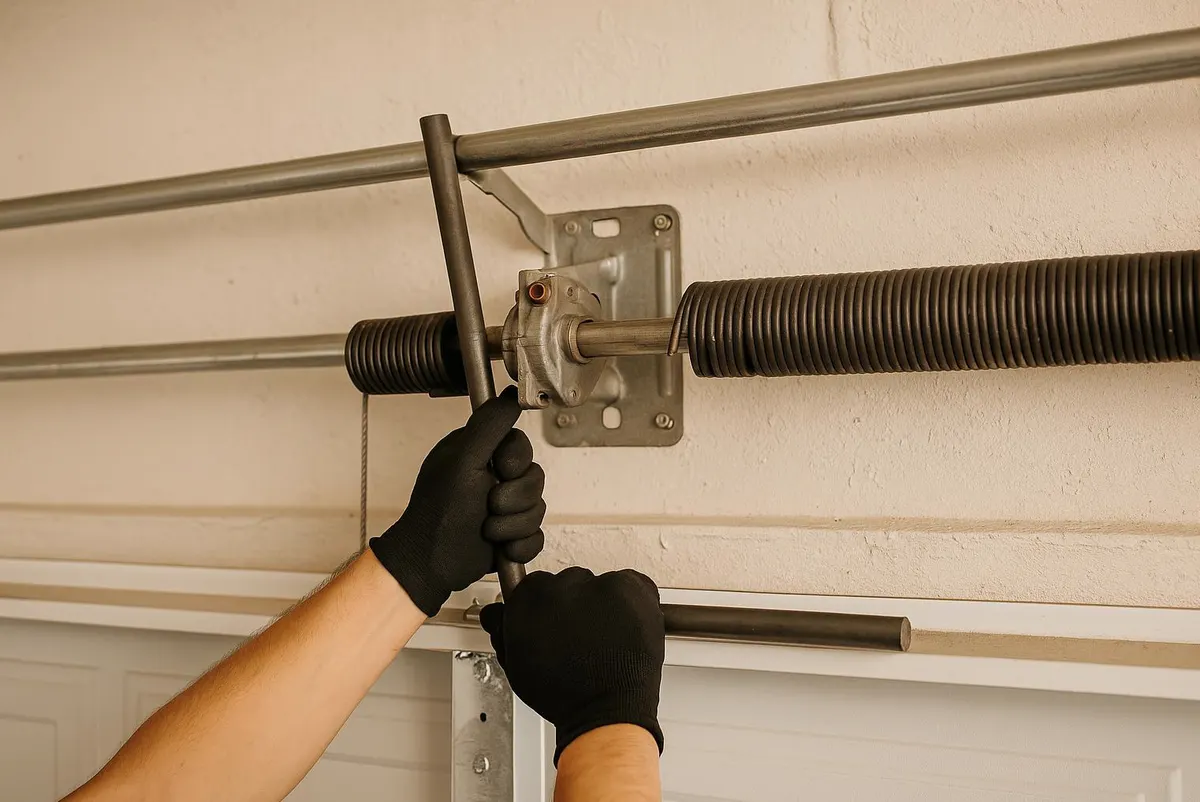
What a Technician Sees on These Calls
Most spring-related service calls in this area start the same way: a homeowner says the door was fine yesterday and now it won't budge, or it slammed down hard enough to rattle the house. By the time we get there, the spring is usually already broken in two, and what looks like a sudden failure was actually weeks or months of quiet wear. Grandridge's heat and humidity speed that process along — moisture works into the coils, rust eats at the metal fatigue points, and afternoon downpours followed by blazing sun create exactly the expansion-and-contraction cycle that shortens spring life. The good news is that worn springs almost always give warning signs first. Here's what to look for before yours lets go.
Walk the Checklist Yourself
1. Look for gaps between the coils
With the door closed, look at the torsion spring above the door (it sits on a shaft over the header). Healthy coils sit tight against each other. If you see daylight between coils in spots, or the coil looks stretched unevenly, that section is fatigued and losing tension. This is often the first visible sign and it means the spring is nearing the end of its life.
2. Check for rust streaks or flaking metal
Surface rust on the spring itself, or orange streaking on the wall or floor beneath it, tells you moisture has gotten into the metal. In humid conditions like Grandridge sees most of the year, rust doesn't just sit on the surface — it pits the metal and creates weak points where the coil is more likely to snap under tension. A light coat of rust is worth monitoring; flaking or crumbling metal means replacement, not maintenance.
3. Disconnect the opener and lift by hand
Pull the emergency release cord and lift the door manually. A door with healthy springs should feel balanced and lift with moderate, even effort, staying put wherever you stop it. If it feels noticeably heavy, drops on its own, or only holds position partway up, the springs are no longer carrying their share of the door's weight.
4. Watch the door's balance as it opens
Reconnect the opener and watch the door through a full cycle. One torsion spring working harder than the other (common when only one spring is replaced during a prior repair, or when one side wears faster) will make the door open crooked, with one corner lagging. This uneven pull also stresses the tracks and rollers, which is a separate repair you don't want to trigger.
5. Listen for new sounds
A loud bang from the garage, even without an obvious cause, often means a spring has already partially failed or shifted on the shaft. Grinding, popping, or a metallic scraping sound during operation can mean a coil is rubbing against itself or the shaft because it's lost proper tension and shape.
6. Inspect extension springs and their cables
If your door uses extension springs (the long springs that stretch above the horizontal tracks, rather than a torsion spring over the header), check how far they stretch when the door is open versus closed. Springs that look permanently elongated, or that have visible separation between coils even at rest, are past their working life. Also check the safety cables running through the springs — frayed or rusted cables here are a real hazard if the spring lets go, since they're what keeps a broken spring from flying across the garage.
7. Note how the opener motor behaves
If your opener seems to strain, run longer than it used to, or you notice the chain or belt jumping slightly, the motor may be compensating for springs that no longer do their job. This often shows up before any visible spring damage and is worth paying attention to, since it puts extra wear on the opener itself.
When to Call Grandridge Garage Door Pro
If you spot gaps in the coils, rust pitting, uneven lifting, or a door that's gotten noticeably heavier to open by hand, it's time to get it looked at rather than wait for a full break — especially heading into hurricane season, when a door needs its spring tension working correctly to hold up against wind load. We handle garage door spring repair and garage door tune-up and maintenance visits throughout Grandridge, Marianna, Sneads, and the surrounding area, replacing worn springs in matched pairs and checking cables, rollers, and balance while we're there.
If your garage door in Grandridge, FL is showing any of these signs, give Grandridge Garage Door Pro a call before it fails on you — we'll come out, take a look, and get it sorted.